How the Village Green Became a Shared Rural Space
Learn how the village green became shared rural space, and why its changing uses still shape local identity, access and everyday community life.
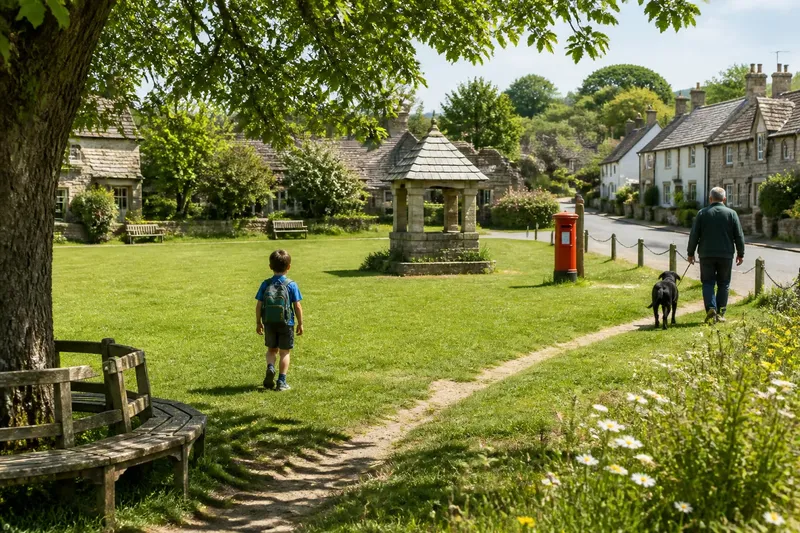
A child cuts across the village green on the way to the post box, while a dog walker follows the worn edge of the grass. The village green may look like a simple patch of open ground, but its shared character took shape through layers of use, custom and local decision-making.
What was a village green?
A village green was an open area associated with a settlement and used by local people for common purposes. The name does not describe one single historical arrangement: greens differed in size, ownership, vegetation and customary use from place to place.
Some were broad grassy spaces; others included a pond, a tree, a well, a roadside strip or a modest piece of ground beside cottages. Their common thread was not a uniform design but a relationship with everyday village life. People crossed them, paused there, brought animals through or used them as a setting for local occasions.
It helps to distinguish a village green from a formal park. A park is often laid out and managed for recreation, with paths, planting and rules set by an owner or authority. A green might be less planned, with its character emerging from repeated local use and the practical needs of nearby households.
How did greens serve villages?
Before a green became a recognised place for leisure and public events, open ground could serve working needs. Where custom or local arrangements permitted, residents might graze livestock, gather fuel or water nearby, dry materials, or use the space as a convenient route between homes and fields.
These uses were shaped by local circumstances rather than a single national pattern. A green near a pond had different practical value from a dry patch beside a road; a settlement with common land nearby might rely on its central space differently from one with little room to spare.
Shared use also made a green a place to exchange news and notice one another’s routines. That social quality could arise without a formal meeting place: people encountered each other while tending animals, walking through or attending to ordinary tasks. In this sense, work and community were not separate activities.
Why did the meaning change?
As rural livelihoods and land use changed, some practical uses became less common or were restricted. Enclosure, changes in farming, new property arrangements and village growth altered who could use particular areas and for what purposes. These shifts were uneven, and the history of any one green depends on its local ownership and records.
Where routine work no longer centred on shared ground, recreation and civic occasions could become more visible. A space once associated with animals or everyday passage might host a cricket match, a fête, a commemorative gathering or simply a bench and a place to sit. This was not always a clean replacement: older rights or habits could remain alongside newer uses.
The green’s meaning also became more symbolic. It could stand for a village’s continuity or shared identity, even when residents used it less often than earlier generations had. That symbolism can be powerful, but it does not tell the whole story: access, maintenance and competing needs still affect who feels welcome there.
Who had a right to use it?
There was never one universal answer. A green might be privately owned, held by a public body or managed through another local arrangement, while customary practices and formal rights varied. The appearance of open access does not by itself establish who owns the land or what activities are permitted.
For a particular place, useful clues include signs, council information, local histories, deeds or records held by a parish or community organisation. Registration as a village green can have legal consequences, but the rules are specific and can be complex. Anyone dealing with a dispute or a proposed change should seek advice from a qualified legal professional or the relevant local authority.
Even where access is broadly welcomed, practical boundaries may matter. Organised events, vehicles, commercial activity, dogs, sports and conservation work can raise different questions. Local notices and management arrangements help make those expectations visible rather than leaving newcomers to infer them from appearance alone.
What does a green mean today?
Today, a village green may work as a place for informal rest, play, local events, access through the settlement or habitat for plants and wildlife. These roles can overlap, though not always without tension. A football game may need clear ground, while a planting project may aim to leave part of the grass longer; a busy event can bring neighbours together and also require careful arrangements.
Its shared quality is therefore less about everyone using it in the same way than about people recognising it as part of local life. That recognition depends on small, visible choices: whether paths are maintained, whether seating suits different users, whether notices explain event arrangements, and whether residents have a way to raise concerns.
Say a parish group wants to make one corner more welcoming without changing the whole green. It could invite residents to mark a simple sketch with the routes they use, places they avoid and features they value, then discuss a modest seating or planting proposal with the land manager. The expected observable result would be a clearer account of local needs before any decision is made, not proof that one design will suit everyone.
How can local history be traced?
Start with what can be observed: the green’s shape, entrances, worn paths, boundary features, mature trees, nearby buildings and any surviving pond or well. These details can suggest how people have moved through and cared for the space, though they cannot establish ownership or date a feature on their own.
Then compare local sources. Parish minutes, historic maps, estate papers, oral histories and photographs may describe changes in boundaries, maintenance, events or access. A local archive, library, parish council or history group can help identify relevant material; comparing sources is useful because each records only part of the story.
Ask residents about names and habits as well as formal events. A corner known by an informal name, a path used on school journeys or a tree associated with annual gatherings may reveal how a place is understood in daily life. Record such accounts as memories, not as a substitute for documentary evidence.
What do readers ask about village greens?
Is every village green publicly owned?
No. Ownership and management vary, and a green that appears open may still have a private owner or specific arrangements. Check local records or ask the relevant council or land manager about the particular site.
Could villagers graze animals on any green?
No single custom applied everywhere, and historic use does not automatically establish a present right. The answer depends on the land’s status, any recorded rights and current local rules.
Are village greens only found in England?
The term is especially associated with English rural settlements, but shared open spaces with comparable community roles exist elsewhere. Their names, ownership systems and histories can differ, so it is better to describe each place on its own terms.
Why do some greens have a pond or a maypole?
Features often reflect local needs, customs or later community choices rather than a standard design. A pond might have served practical purposes, while a maypole can mark a particular tradition; local records and residents’ accounts can clarify what a feature means in that village.
Why the shared space matters
The history of a village green is not simply a story of a working space becoming a leisure space. It is a record of how neighbours negotiated access, adapted land to changing needs and attached new meanings to familiar ground.
For anyone curious about a local green, begin with one modest question: who uses this space, and what do they use it for? That question links the visible ground to the community around it, and keeps the village green’s shared purpose in view without assuming that its past or present is the same everywhere.