Why a Familiar Lane Can Feel Different on the Return
A familiar lane can feel different on the return: notice how direction, light and attention reveal small details in a route you already know.
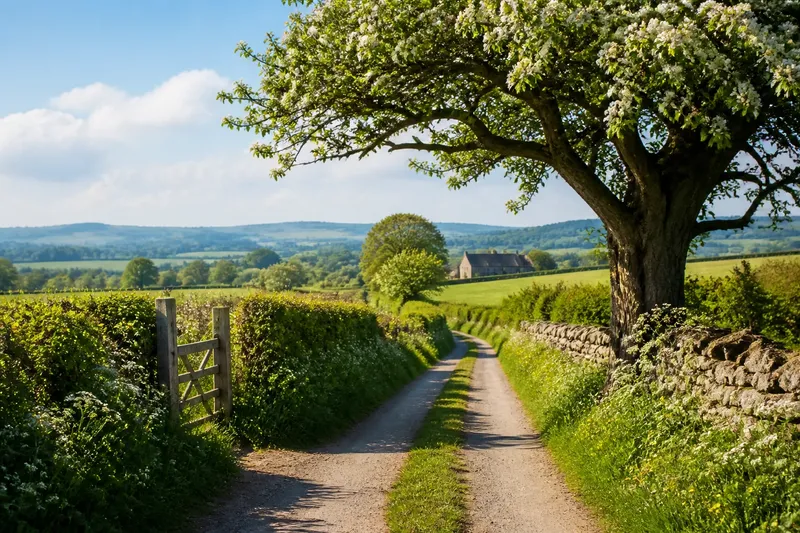
You walk out along the lane with your eyes on the gate ahead; on the way back, the old hawthorn seems to have acquired a shape you had never noticed. A familiar lane can feel different on the return because the view has changed direction, the light has shifted, and your attention is no longer doing quite the same work.
That difference does not mean the outward walk was inattentive or that the landscape has transformed. A route is not a single picture stored in memory. It is a sequence of views, sounds and choices, and turning round changes how those elements meet you.
One route, two views
Walking towards a landmark and walking away from it produce different arrangements. From one direction, a hedge may hide the bend; from the other, the bend opens towards a field. A farmhouse roof that served as a distant marker on the outward journey might disappear behind trees on the return.
Even when the path itself is straight, its surroundings are not symmetrical. A ditch lies on one side, a wall on the other; a tree’s branches spread more fully against one background than another. The lane has not changed, but your position within its pattern has.
It can help to think of the route as a familiar room entered through another door. The furniture is the same, yet its order and prominence seem different from that angle. On a lane, the “furniture” might be a stile, a patch of nettles, a distant church tower or the pale underside of a leaf.
Direction changes landmarks
On the outward leg, walkers often settle on a destination: the next bend, a bridge or the point where the track meets a wider road. That destination can organise the view. Smaller features become background while the eyes keep returning to the place that marks progress.
On the return, the destination is familiar and often less visually demanding. The gaze can move elsewhere: to the uneven line of a hedge, a gap between buildings or the way a stream crosses beneath the lane. A detail that was always present becomes noticeable because it is no longer competing with the same visual goal.
Direction also changes what counts as a useful cue. A distinctive oak may be easy to recognise when approaching it, but less obvious once it is behind you. Conversely, a slope or roofline may stand out when it points towards home. These cues help the mind place itself along a route, even when you are not consciously checking where you are.
Light reshapes familiar forms
Light arrives from a particular direction and falls differently on each side of the lane. When you turn round, the lit and shaded faces of hedges, walls and trunks trade places in your view. Texture that was subdued may become clear; a bright surface may lose its definition when seen from another angle.
Cloud, season and the height of the sun matter too, but no special weather is needed. A break in cloud can brighten one field while leaving the next in shade. Wet leaves may reflect light on the way out, while a gust has dried them by the time you pass again.
Distance can be deceptive as well. A familiar hill viewed against a bright sky may seem sharply outlined, while the same hill from the opposite direction merges with nearby slopes. The outline has not moved. The contrast around it has altered what your eyes can separate.
These changes are often modest, which is why they reward a little patience. You need not identify every plant or explain every shift. Noticing that the stone wall looks rougher from this side is already a way of meeting the place afresh.
Attention follows a different task
Walking involves practical attention. You watch for a muddy patch, make room for a passing vehicle or choose where to place your feet. Those needs are sensible, but they can narrow the view to whatever is directly relevant at that moment.
Once the route feels secure, attention may loosen. The eye can linger on a bird moving along the hedge, while the ear picks out water or a distant tractor. If you are thinking about what waits at home, however, the return may pass without much notice. The direction alone does not make anyone more observant; it simply offers a chance to attend differently.
There is no need to turn the walk into a concentration exercise. A small prompt is enough: look once at the ground, once at the middle distance, then let your gaze settle where it naturally goes. This can widen the scene without asking you to monitor every detail.
A small noticing practice
Choose one ordinary feature on a route you already know and check it on both legs of a walk. It might be a particular gate, a bend in a stream or the crown of a roadside tree. The aim is not to find something remarkable but to give one steady point of reference a little attention.
Say you often walk from the village towards a stone bridge. On the outward leg, you notice a low branch hanging above the verge; on the return, you see that the branch frames the bridge from the other side. The expected result is not a new discovery about the lane, but a clearer sense of how the view changes with your position.
You can keep the practice simple:
- Choose a safe, familiar stretch rather than a route that demands constant navigation.
- Pick one feature that is easy to recognise from both directions.
- Notice its shape or colour on the outward walk without stopping in an unsafe place.
- Look for the same feature on the return and compare what sits behind it.
- Notice whether light, shadow or your own pace changes what stands out.
- Leave the observation there; no notes or conclusions are needed unless they appeal to you.
If the lane has traffic, livestock or uneven ground, give those practical demands priority. Observation can happen while moving at a comfortable pace, or from a safe place where you are not obstructing others.
What does the return reveal?
Why does a familiar route seem unfamiliar?
The route may appear altered because direction changes the arrangement of landmarks and the view behind them. Shifts in light and attention can also bring forward details that were less visible or less relevant on the outward leg.
Does the landscape actually change during a short walk?
Sometimes a breeze moves grasses, cloud changes the light or a bird crosses the path. Often, though, the main change is in your viewpoint: you are seeing the same hedge, field or building from a different angle.
How can I notice more without slowing down?
Choose one feature to look for rather than trying to take in the whole lane. A brief glance at its outline, background or shadow can be enough, provided your attention remains on footing and other immediate hazards.
What if I notice nothing different?
That is a perfectly ordinary outcome; not every walk offers a striking contrast. You might simply confirm that the gate, wall or tree looks much as you remembered, and let the walk continue.
Familiarity leaves room
Knowing a lane well has practical value: you recognise the muddy corner, know where the verge narrows and can walk without repeatedly working out the route. That familiarity can also leave more attention available for small variations, though it does not require you to search for them.
Next time you turn back along a known path, let one familiar detail be your point of return. The main search phrase, “a familiar lane can feel different on the return”, describes a simple experience: the place stays recognisable while your angle, the light and the focus of your attention make another version of it visible.